The Biorevolution Podcast with Andreas Horchler and Louise von Stechow – father and daughter, journalist and biologist, talking about the technologies of the biorevolution. Can genetic engineering, synthetic biology, and artificial intelligence save humanity from disease, climate change, and overpopulation, or are these technologies the first step towards its downfall?
Content and Editing:
Louise von Stechow and Andreas Horchler
Disclaimer:
Louise von Stechow, Andreas Horchler and their guests express their personal opinions, which are founded on research on the respective topics but do not claim to give medical, investment, or life advice in the podcast.
Learn more about the future of biotech in our podcasts and keynotes. Contact us here:
scientific communication: https://science-tales.com/
Podcasts: https://www.podcon.de/
Image: Kelly Sikkema via Unsplash
The Biorevolution Podcast
Louise von Stechow
Beschreibung
Publisher & Vermarkter
Wer diesen Podcast veröffentlicht und wer die Werbeplätze vermarktet.
- Publisher Uns liegen aktuell keine Daten zum Publisher vor.
- Vermarkter Uns liegen aktuell keine Daten zum Vermarkter vor.
Podmon Kategorien
Darüber wird in diesem Podcast anteilig gesprochen.
Anzahl Kategorien
Upgrade dein Konto, um kontextuelle Kategorien zu sehen!
Chartplatzierungen
Aktuelle Platzierungen in den öffentlichen Podcast-Charts und in unseren eigenen Kategorien.
Apple Podcasts
PODMON Kategorien
Veröffentlichungshistorie
Episodenübersicht
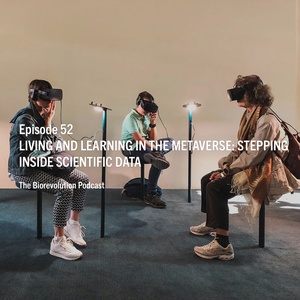
Living and Learning in the Metaverse: Stepping Inside Scientific Data
01.10.2026
The BioRevolution Podcast - Episode 52
For centuries, scientists have relied on visual representations to make sense of the world, from anatomical drawings and microscopy images to increasingly complex computational visualizations. Yet most scientific data still ends up on a flat screen. Extended reality (XR), including virtual and augmented reality (VR, AR), offers new ways of interacting with information. Researchers can step inside a dataset, such as the Human Reference Atlas (HRA) and move around structures, manipulate them with their hands, change scale, and explore the same virtual space together.
With Dr. Andreas Bueckle, Research Lead at the Cyberinfrastructure for Network Science Center at Indiana University Bloomington, we discuss what a metaverse for scientists could look like and what scientists can learn from gamers about virtual spaces.
Find Andreas’s website here: https://andreas-bueckle.com/
Find Andreas’s LinkedIn here: https://www.linkedin.com/in/andreas-bueckle/
Watch Andreas’ TEDx talk “Living and Learning in the Metaverse”: https://www.youtube.com/watch?v=BpnLKoAK1YE
Explore the HRA Organ Gallery: https://humanatlas.io/hra-organ-gallery
Image: Lucrezia Carnelos via Unsplash
References
Milgram P, Kishino F. (1994). A Taxonomy of Mixed Reality Visual Displays. IEICE Transactions on Information and Systems E77-D(12):1321–1329.
Chandler T, Cordeil M, Czauderna T, et al. (2015). Immersive Analytics. IEEE Big Data Visual Analytics. DOI: 10.1109/BDVA.2015.7314296
Skarbez R, Smith M, Whitton MC. (2021). Revisiting Milgram and Kishino's Reality-Virtuality Continuum. Frontiers in Virtual Reality. https://doi.org/10.3389/frvir.2021.647997
Ens B, Bach B, Cordeil M, et al. (2021). Grand Challenges in Immersive Analytics. Proceedings of CHI 2021. DOI: 10.1145/3411764.3446866.
Bueckle A. (2022). Living and Learning in the Metaverse. TEDxIndianaUniversity.
Bueckle A, Buehling K, Shih PC, Börner K. (2022). Optimizing Performance and Satisfaction in Matching and Movement Tasks in Virtual Reality with Interventions Using the Data Visualization Literacy Framework. Frontiers in Virtual Reality 2:727344. DOI: 10.3389/frvir.2021.727344.
Korkut EH, Surer E. (2023). Visualization in virtual reality: a systematic review. Virtual Reality 27:1447–1480. DOI: 10.1007/s10055-023-00753-8.
Bueckle A, Qing C, Luley S, Kumar Y, Pandey N, Börner K. (2023). The HRA Organ Gallery affords immersive superpowers for building and exploring the Human Reference Atlas with virtual reality. Frontiers in Bioinformatics 3:1162723. DOI: 10.3389/fbinf.2023.1162723.
Saffo D, Di Bartolomeo S, Crnovrsanin T, et al. (2024). Unraveling the Design Space of Immersive Analytics: A Systematic Review. IEEE Transactions on Visualization and Computer Graphics 30(1). DOI: 10.1109/TVCG.2023.3327368
Kumarapeli D, Jung S, Lindeman RW. (2024). Privacy threats of behaviour identity detection in VR. Frontiers in Virtual Reality 5:1197547. DOI: 10.3389/frvir.2024.1197547.
Börner K, Blood PD, Herr BW II, et al. (2025). Human BioMolecular Atlas Program (HuBMAP): 3D Human Reference Atlas construction and usage. Nature Methods. DOI: 10.1038/s41592-024-02563-5.
Ning X, Zhuo Y, Wang X, Sio C-ID, Lee L-H. (2025). When Generative Artificial Intelligence Meets Extended Reality: A Systematic Review. arXiv. DOI: 10.48550/arXiv.2511.03282.
Bueckle A, Zhu C, Wong AYH, et al. (2026). Multiscale harmonization and semantic integration of biomedical data enable biological insights through immersive exploration. bioRxiv. DOI: 10.64898/2026.07.07.737090.
Bueckle A, Hütter CVR, Raidou RG, et al. (2026). Challenges and Opportunities for Theory-Grounded Data Visualization in Extended Reality. IEEE Computer Graphics and Applications 46(4):111–118. DOI: 10.1109/MCG.2026.3685140.
Mora P, et al. (2026). Refugio: a voice-driven generative virtual reality “safe place” for personalized emotion regulation. Frontiers in Virtual Reality. DOI: 10.3389/frvir.2026.1760765.
Lab-in-the-Loop: AI bridges to the wet lab
31.08.2026
The BioRevolution Podcast - Episode 51
Artificial intelligence is increasingly becoming part of the scientific process itself. Beyond analyzing data or predicting molecular structures, emerging AI co-scientists can generate hypotheses, critique ideas, search the literature, propose experiments, and interpret results. In lab-in-the-loop approaches, these computational systems are connected with wet-lab experimentation and automation, creating iterative cycles in which models learn from experimental data and suggest what to test next.
Recent systems from Google DeepMind, FutureHouse/Edison Scientific, and Stanford s illustrate how quickly this field is developing. Yet questions remain around scientific novelty, data quality, hallucinations, bias, and whether faster science necessarily means better science.
With Dr. Thibault Geoui, life-science and AI expert at Zühlke and host of the Tech and Drugs podcast, we discuss the rise of AI co-scientists and self-driving labs, where the real bottlenecks in AI-driven drug discovery lie, and how the role of human scientists may change as AI moves from software tool to scientific collaborator.
Find Thibault here: https://www.linkedin.com/in/thibaultgeoui/
Listen to the Tech and Drugs podcast here: https://youtube.com/playlist?list=OLALYPui2n_zY5D4atXf3KbIcPUSQcWN7-A&si=V5-C6KIIOMpGonI7
Read Thibault’s Newsletter here: https://www.linkedin.com/newsletters/7036361021543866369/?displayConfirmation=true
Disclaimer:
Louise von Stechow & Andreas Horchler and their guests express their personal opinions, which are founded on research on the respective topics, but do not claim to give medical, investment or even life advice in the podcast.
Learn more about the future of biotech in our podcasts and keynotes. Contact us here:
scientific communication: https://science-tales.com/
Podcasts: https://www.podcon.de/
Keynotes: https://www.zukunftsinstitut.de/louise-von-stechow
https://www.nature.com/articles/s41586-026-10644-y
https://www.nature.com/articles/s41586-026-10658-6
https://www.nature.com/articles/s41586-026-10652-y
https://www.fiercebiotech.com/biotech/openai-launches-biotech-specific-ai-model-gpt-rosalind
https://www.medrxiv.org/content/10.1101/2025.07.07.25331008v
https://www.nature.com/articles/d41586-025-02028-5
https://arxiv.org/abs/2410.09403
https://www.nature.com/articles/d41586-023-02218-z
https://valutric.com/googles-ai-co-scientist-vs-openais-deep-research-vs-perplexitys-deep-research/
https://www.nature.com/articles/d41586-025-00343-5
https://www.nature.com/articles/d41586-024-02842-3
https://sakana.ai/ai-scientist-first-publication/
https://www.wired.com/story/ai-scientist-ubc-lab/
https://research.google/blog/accelerating-scientific-breakthroughs-with-an-ai-co-scientist/
https://arxiv.org/abs/2502.18864
https://www.nature.com/articles/d41586-025-01485-2
https://www.science.org/content/blog-post/evaluation-deep-research-performance
https://modernsciences.org/openai-deep-research-agent-ai-tool-limitations-february-2025/
https://www.nature.com/articles/d41586-025-00377-9
https://arxiv.org/abs/2409.13740
https://www.nature.com/articles/d41586-024-01684-3
https://www.nature.com/articles/s44286-023-00002-4
https://pmc.ncbi.nlm.nih.gov/articles/PMC10700133/
https://www.nature.com/articles/s41586-025-09922-y
https://www.nature.com/articles/d41586-026-01551-3